2023–2024
SkillsUSA Mobile Robotics
How our two-person team designed, tested, and refined a national fourth-place competition robot.
- My role
- Team captain in 2024 · Two-person team
- Objective
- Design and refine a robot for scoring and autonomous tasks
- Tools & methods
- CAD · VEX V5 · 3D printing · Programming
- Current result / status
- Three NJ titles; fourth nationally in 2024
The challenge
For the 2023–2024 SkillsUSA season, Anthony Wolk and I built a robot for the VRC Over Under game adapted to the Mobile Robotics Technology competition. Our two-person team needed to collect, launch, push, and score Triballs, complete autonomous routines, and elevate the robot during the endgame. I served as team captain and helped restart our school’s robotics program.
We prioritized reliable scoring cycles and a manageable elevation system. Game analysis shaped the drivetrain layout, intake, launcher, and autonomous strategy before we committed to detailed designs.
Mechanical design
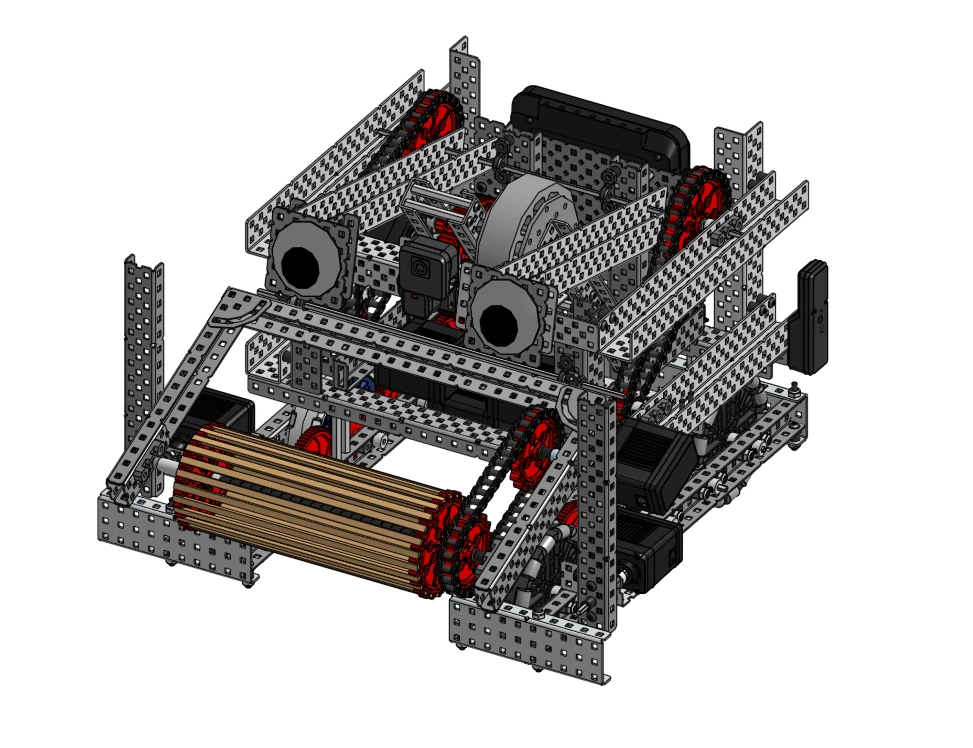
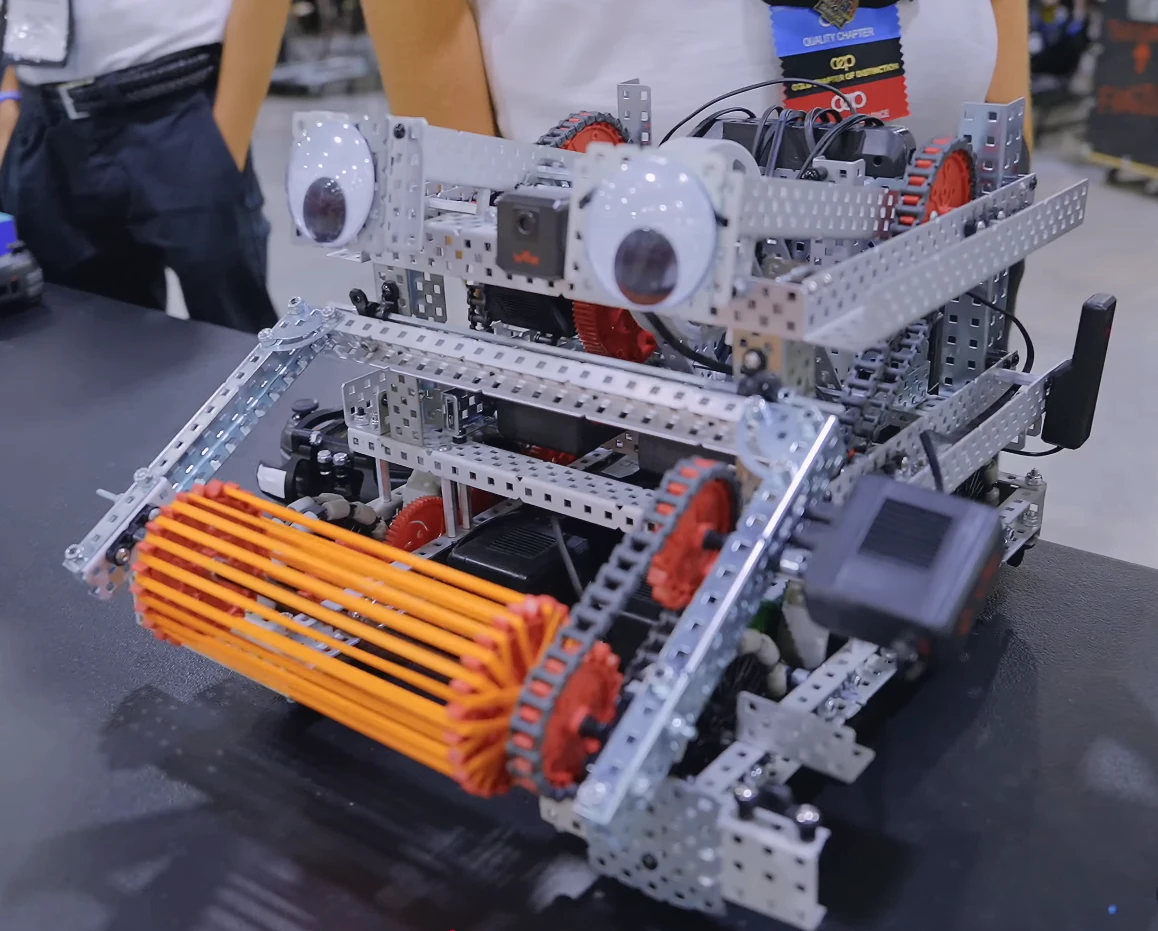
The robot used a six-wheel tank drivetrain powered by four V5 motors. We considered mecanum wheels and tank treads before selecting a layout that balanced traction, control, and simplicity. The structural frame supported the mechanisms while leaving room for subsystem integration within the 18 × 18 × 18 inch starting envelope.
A rubber-band roller intake collected Triballs with a lightweight, compliant contact surface. Motor-driven folding arms expanded the robot’s pushing reach near the goals, while an elevation mechanism supported the endgame strategy.
What testing changed
| Problem | Change | Observed result |
|---|---|---|
| The chassis caught on field barriers during turns. | We reduced its footprint from about 17.5 × 17.5 inches to 15.1 × 16.4 inches. | Turning clearance and driver control improved. |
| The rack-and-pinion launcher suffered friction, bending, and wear. | We replaced it with a flywheel launcher and a custom 3D-printed VersaHub. | The launcher became more durable and consistent. |
| The flywheel overshot its target. | We tuned motor velocity, settling near a 35% setting during testing. | Launch distance and scoring consistency improved. |
| The robot tipped forward while elevated. | We repositioned standoffs to adjust the hanging point. | The robot elevated with better balance. |
Autonomous programming
Our autonomous sequence combined drivetrain movement, GPS-assisted positioning, flywheel launching, and elevation tasks. It began by scoring a preload, aligning with the loading zone, and launching Triballs. Heading corrections then helped reposition the robot for the elevation sequence.
We tested alignment, launch consistency, and timing repeatedly. Faster movements sometimes introduced errors, so we balanced speed with repeatability. This showed me how small mechanical inconsistencies can affect sensor-based movement and software behavior.
My role and our workflow
As captain of a two-person team, I helped organize subsystem priorities, CAD work, fabrication, programming, testing, and competition preparation. Both of us contributed across the project. Between matches, we diagnosed problems, repaired mechanisms, adjusted routines, and discussed strategy.
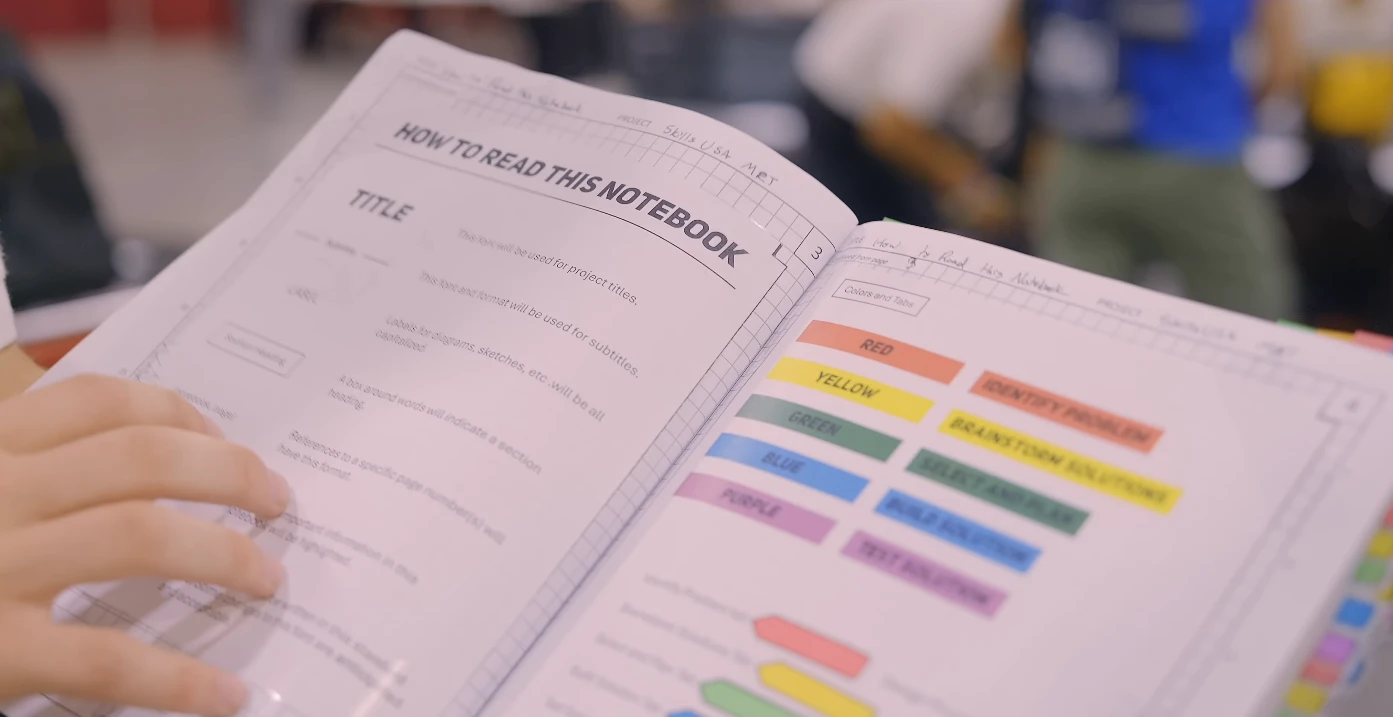
We documented concepts, revisions, test observations, and programming decisions throughout the season. We built the notebook pages in PowerPoint, then printed and assembled them into a physical notebook for competition.
Results and lessons
We won the 2023–2024 New Jersey SkillsUSA State Championship and placed fourth nationally. This followed our New Jersey state titles in 2022 and 2023. SkillsJAM documented portions of our development and competition experience.
The biggest lesson was that reliable, serviceable mechanisms mattered more than complexity. In a future version, I would focus on reducing weight, improving packaging and repair access, and refining autonomous routines with additional sensor feedback.